

AI, Market Research and CX: From Promise to Practice
AI personas, synthetic panels and customer insights: how can AI enhance market research and CX without replacing insights from real consumers?
AI personas, synthetic panels and customer insights: how can AI enhance market research and CX without replacing insights from real consumers?
When AI comes up in customer listening and market research, the debate quickly becomes polarized. On one side is the promise of near-instant, low-cost insights, alongside the pressure to boost performance and productivity through AI. On the other is a lack of understanding of how different AI approaches work, the somewhat “black box” nature of some methods and, ultimately, the fear of hasty decisions based on “fake” consumers or insights that only scratch the surface. Both perspectives miss the point.
The challenge is not to choose between AI and field research, but to know at what stage of the customer insight process each approach offers the greatest value. For example, where we once relied on brainstorming - or even a “gut feeling” (and how many of you have seen tactical decisions made on the fly in corridor conversations for lack of available insights?) - AI now makes it possible not only to synthesize existing information, but also to simulate, iterate and screen hypotheses before taking an offering or concept further in development.
AI, then, is not merely a tool to use occasionally, but a methodology to embed in how organizations gather and develop customer knowledge.
First, it is worth identifying and organizing the strengths of generative AI. It offers three concrete benefits that teams are already seeing in practice.
Synthesis: condense to decide. AI can synthesize thousands of customer comments, reviews or after-sales support tickets in minutes. It codes open-ended responses, detects emerging themes and finally puts to use the vast quantities of CX data that had gone untapped for lack of manpower. This is often its first application - or the first proof of concept developed within organizations. Research findings and datasets can be combined more easily and turned into clear, prioritized insights: in-depth profiles, survey summaries and recommendations.
Search: index, retrieve and connect. AI now makes it possible to query the full body of available knowledge (internal research, segmentations, open data) in natural language, retrieving scattered information and connecting the dots. This breathes new life into research repositories and knowledge-management interfaces (no more tedious manual document tagging), strengthens customer centricity and improves internal sharing of customer knowledge.
Conversation: engage with your customers. AI's conversational capabilities can already enhance existing customer insight programs. For example, AI voice agents can make surveys easier to administer, while automated, context-aware follow-up questions can deepen responses to traditional open-ended questions. But the greatest value of conversation is also, and above all, the opportunity to create new ways of interacting with our customer insight data: conversational personas and synthetic panels can be questioned as though they were real consumers, to gather insights and test claims, visuals and concepts at any time. Reports and data become conversations rather than one-off presentations of findings, bringing the end customer to the heart of organizations in a permanent, accessible way.
These benefits nevertheless require a robust methodology, because generative AI was not designed either for businesses or for customer insight.
Generative AI was designed for the general public, to answer questions about anything for anyone. It is unfamiliar with companies' data, rules and processes and tends to draw on what is readily available on the internet, producing probabilistic, averaged-out and generic findings. For it to speak credibly about your customers, it must be grounded in the organization's data and insights: CX journeys and internal research, segmentations, customer comments, and carefully selected and validated open data.
Generative AI was also designed to show empathy and agree with its users. This is the well-known agreement bias: the model tends to endorse whatever is put to it, which makes it unsuitable for testing ideas or co-creating a concept. It is therefore essential to counter this natural tendency through prompts that address these biases. This can mean adding decision-making mechanisms or values to a synthetic persona, introducing safeguards against LLMs' overexposure to current events by weighting synthetic panels, or building in contradictions to reflect the complexity of gaps between stated opinions and actual behavior. A synthetic persona is built to evaluate, not to validate.
Using generative AI for customer insight therefore does not remove the need for method and guiding principles. In particular, AI must be placed in context and prompted appropriately so that its outputs reflect both the business environment in which it is used and the realities of the consumers it represents. Two applications currently bring these challenges into focus: AI personas and synthetic panels.
Personas have been around for years in research, marketing and CX teams. Their limitation is well known: once the presentation is over and the posters are on the walls, they rarely remain top of mind or see much use. Customer segmentations are often forgotten or used only superficially - until the next update.
AI personas give customers their voice back and make them permanent conversation partners for decision-makers. They are built from real data (customer journeys, research, CRM, verbatim feedback and behaviors). The more data and research an organization has, the more relevant and credible these AI personas become. Prompts also need to be designed to prevent the familiar problem of hallucinations and to anchor these interactive reporting tools in the customer documentation used to create them. The persona then becomes a genuine interactive dashboard or report, making customer knowledge and perceptions accessible internally, helping teams immerse themselves in consumers' everyday lives and enabling hypothesis testing, sometimes in real time during a meeting or executive committee session.
Use cases are tangible and rapidly expanding: integrating personas into innovation sprints or workshops, using them in employee onboarding, and creating training simulations - particularly in B2B, where sales people can rehearse their pitches virtually before meeting prospects. Depending on the data available within organizations and from open sources, it is possible to model specific consumer segments, but also professional profiles (electricians, as illustrated below, lawyers, key-account customers, etc.) or hard-to-reach audiences - making them continually accessible - such as people with particular medical conditions. In practical terms, different profiles can be taken through a customer journey or complaints process to anticipate friction points; a brand promise can be tested with both a digitally skeptical older consumer and a time-pressed young professional. Most importantly, this gives marketing, product, IT and customer service teams - as well as colleagues who rarely read research reports - a way to engage in conversation with “their” customers.

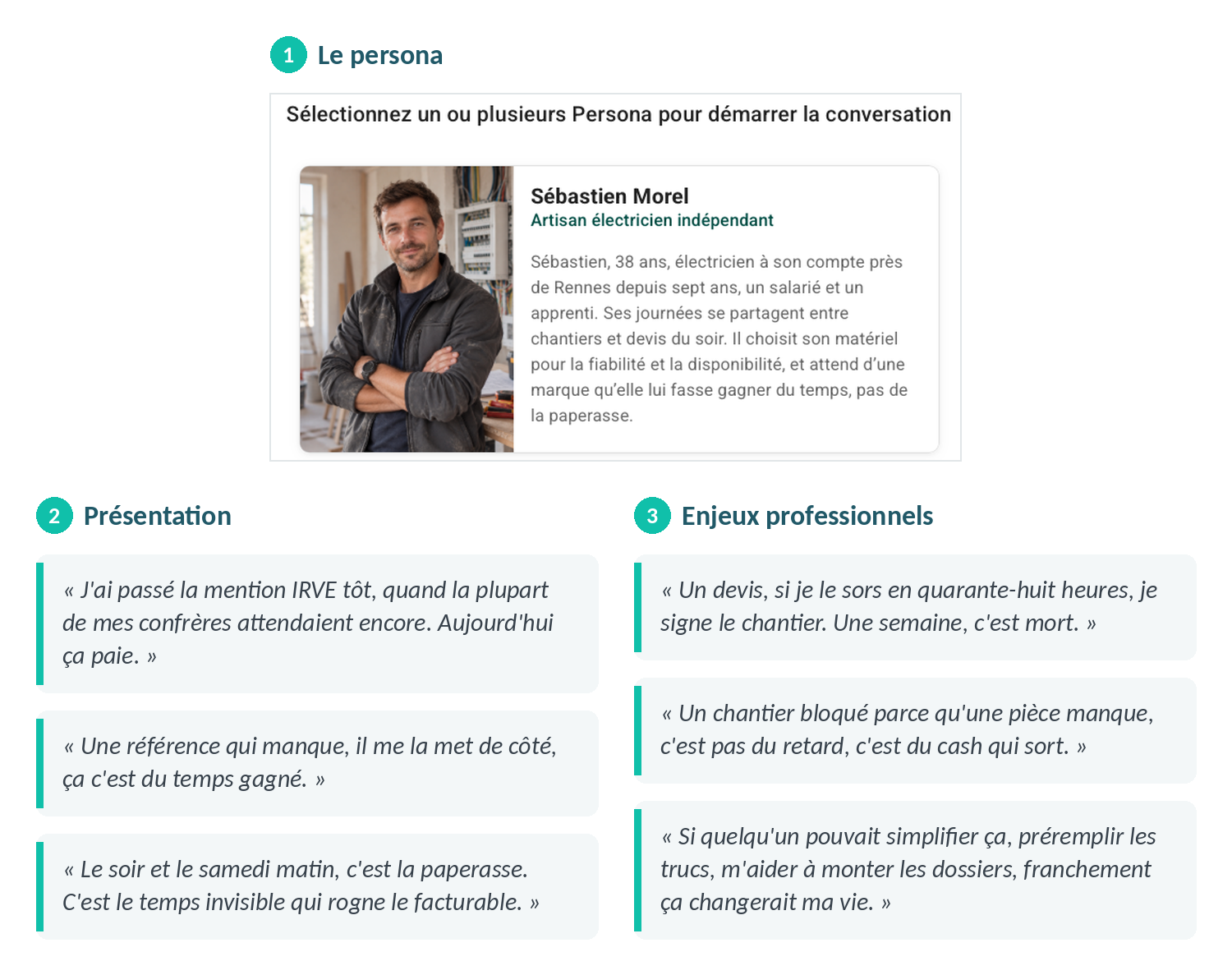

A persona thus sheds light on the distinct profiles within a segmentation. To reason about an entire population and obtain orders of magnitude, however, we need to move to a different scale.
Synthetic panels go a step further, replicating the behaviors and attitudes of entire populations. The aim is not to imitate studies conducted with “real” consumers, but once again to use the synthetic approach where it is appropriate - while remembering the biases inherent in self-reported answers from “real respondents” (limited attention spans, social desirability bias, intentions that are never acted upon, and post-hoc rationalization). In short, the idea is to combine the best of both worlds and use each according to the context and need. Two approaches to AI-powered quantitative research can be distinguished.
Synthetic panels: configure to explore. The goal is to recreate a given population (often a nationally representative sample to ensure a sufficient base) using public benchmark data (INSEE, ARCEP, ADEME, etc.), a psychographic layer (the values and decision-making criteria that help counter agreement bias) and a narrative layer (relevant life situations depending on the intended use of the panel).
Digital twins: replicate to simulate. This approach reproduces an existing database (CRM contacts, loyalty program members, etc.) to create digital counterparts of the individuals it contains, which can then be questioned as often as needed - usually on tactical issues - without over-surveying respondents, so their participation can be reserved for in-depth, high-priority or strategic research.
Consider a use case that illustrates the benefits of synthetic panels. You oversee branches at a major bank and are thinking about their future: as city centers lose footfall and customer journeys become increasingly digital, branches need to reinvent themselves. To kick-start a brainstorming session, you could begin by launching a synthetic survey exploring how often people visit branches and why, alongside testing a few potential new services.
Respondents acknowledge that almost all banking transactions can now be carried out online. Human contact (33%) and personalized advice (32%) remain the leading reasons for visiting a branch, alongside resolving problems and complaints (23%) - even if that is probably not advisors' favorite appointment! Interest in new services remains high, especially access to experts and help with administrative procedures. Synthetic panels deliver not only quantitative results, but also conclusions and recommendations. In this case, three directions emerge: essential “digital–human integration” (the desire for personalized advice spans all generations), “the branch as a place for problem resolution” (when digital interfaces fail, customers seek human expertise to unblock situations with high perceived value), and finally the “one-stop-shop bank” (a demand for simplification, especially among younger customers).
The tool even proposes concepts, ranging from a streamlined administrative hub that makes the branch a facilitator to the less obvious idea of a temporary, connected workspace focused on productivity.
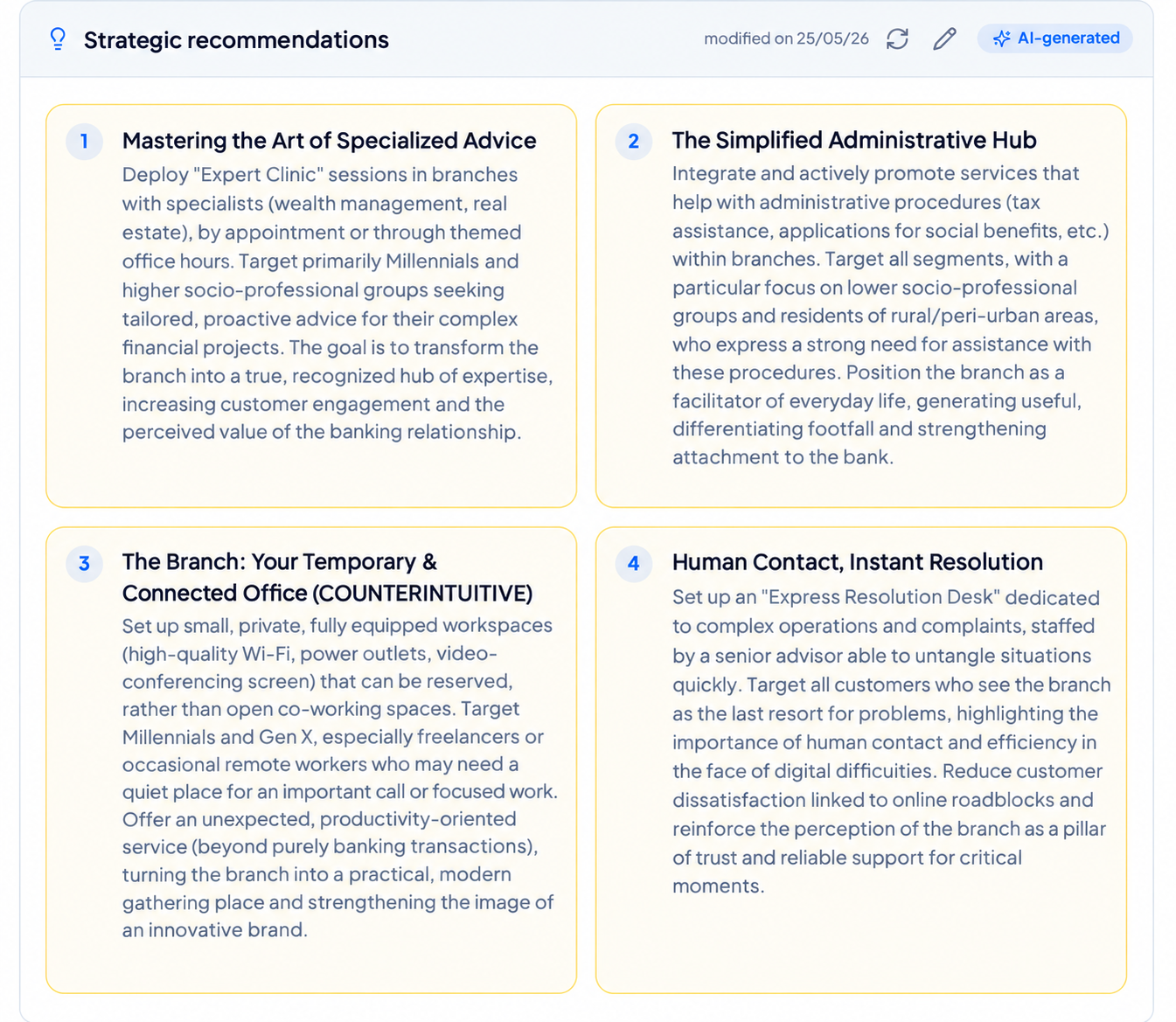
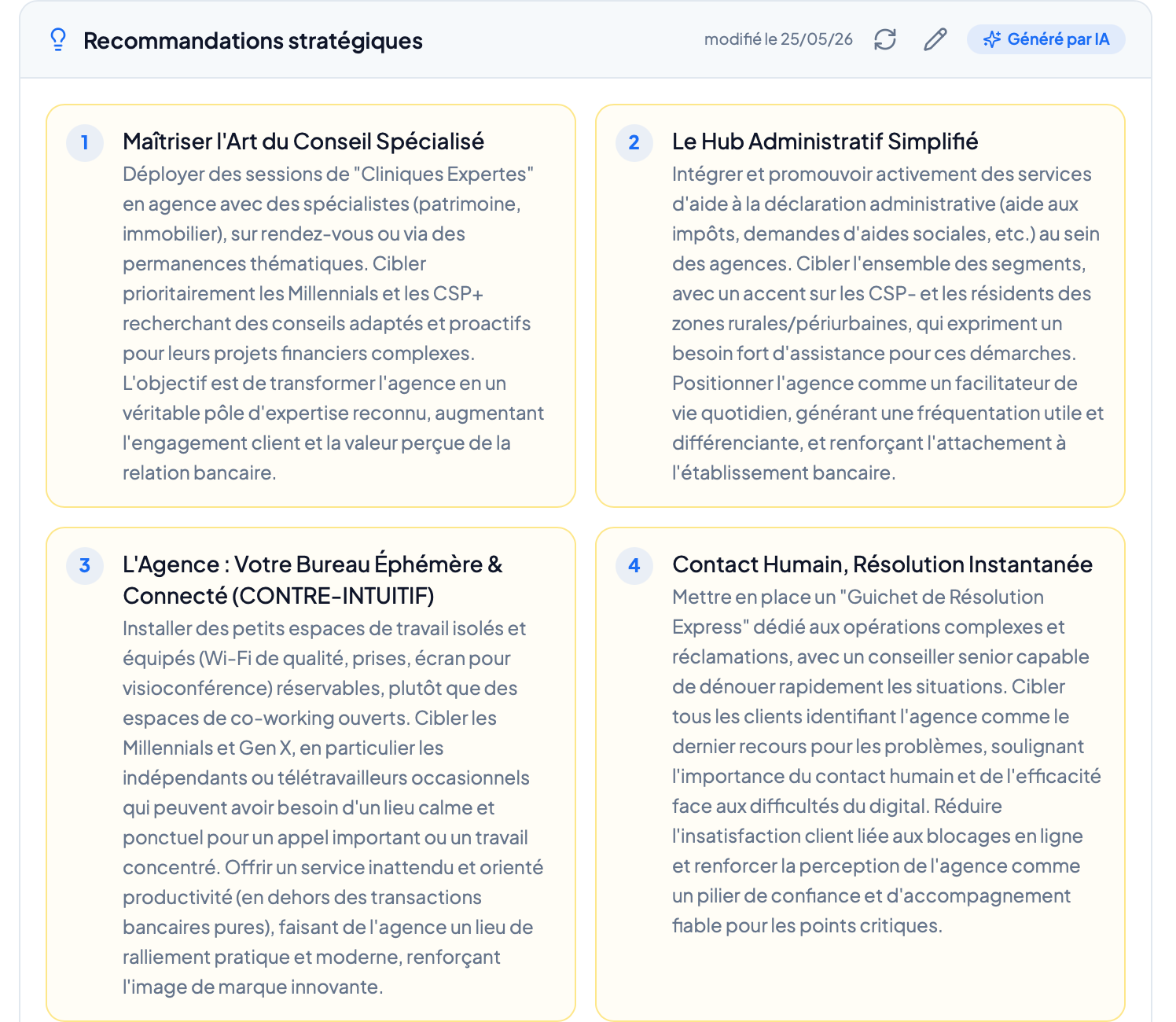

Ultimately, just 30 minutes to obtain supporting arguments, conclusions and even personas! Enough to fuel an initial working meeting rather than starting from scratch or preconceived ideas. Some clients use the term “synthetic groundwork,” which feels exactly right: we are not building yet; we are exploring hypotheses and clearing the ground to see where to dig deeper. And this process can be repeated: we enrich a future concept with the initial feedback, iterate with the same sample, and can even convene a virtual focus group with the most interested personas before validating the findings with the bank's prospects and customers.
The synthetic panel, therefore, is not intended to replace research or Voice of the Customer programs: it prepares, enriches and complements them, provides ongoing access to customer perspectives, and helps foster a customer-centric culture.
AI personas and synthetic panels are not substitutes for field-based customer insight. They represent new stages of customer centricity, providing continuous access to customer perspectives to better understand their challenges and test hypotheses in depth, while introducing new processes where decisions were often guided by intuition alone.
The question, then, is no longer whether to be for or against AI, but rather: what practices, rituals and rules should we develop? Those who start now will build the most valuable knowledge of all: knowing when these approaches are appropriate and help speed up decisions.


Discover Your Potential With Us Today.

